

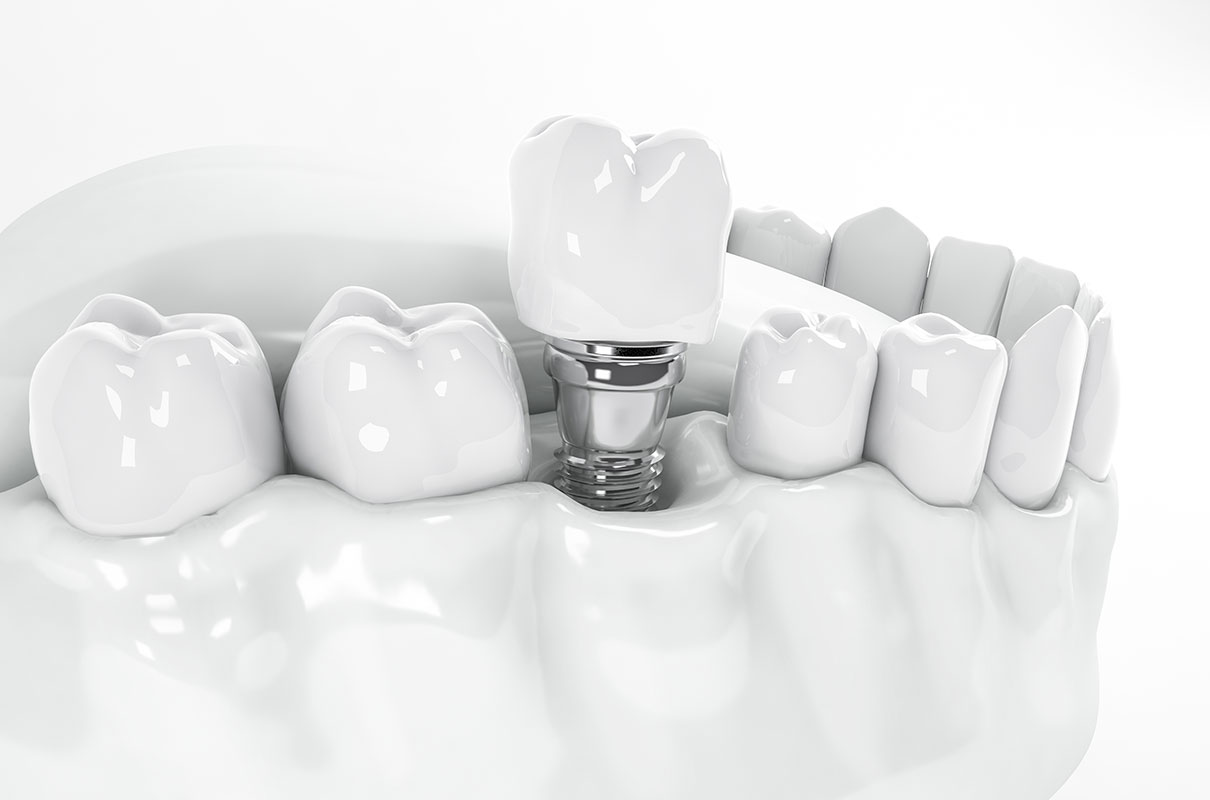
Implant surgery is a treatment method that has been applied to people since the 1960s and continues to be applied reliably all over the world today. An ideal surgical application, the use of a compatible prosthesis and a correct oral hygiene protocol can successfully function in the jaw for years. In cases of general health problems such as diabetes, osteoporosis etc., inadequate oral hygiene, heavy smoking etc., supporting bone destruction and tooth loss can be seen in natural teeth, and the same problems can be seen in the presence of implants. Therefore, implant treatments are an optimum option to protect current and remaining teeth, but they are applications that require great care in terms of planning, application and maintenance.
If it is possible to perform root canal treatment again and restore the tooth with methods such as composite filling, onlay or crowns in teeth with large fractures or decayed tissue, insufficient root canal treatment, and major root apex lesions, it may be more beneficial to give these types of teeth another chance rather than implant treatment. Because after each tooth extraction, a certain level of bone loss can be encountered in the relevant area. Therefore, restoring a natural tooth to health and keeping it in the mouth is the primary treatment approach. However, if there is a great deal of damage that cannot be repaired, if the bone surrounding the tooth has completely resorbed on a surface due to infection, or if there is periodontal loss/bone loss at a level that generally does not allow the tooth to remain stable in the mouth, implant treatment is the most appropriate treatment option.
Implant treatments can be safely applied to all individuals whose development is complete, who do not have any general health problems or whose diseases are under control. Sometimes implants can be applied to a developmentally deficient tooth area, sometimes in the same session following the extraction of the tooth or by waiting for the recovery period after the extraction. It is a much more protective treatment alternative compared to bridge treatments applied by grinding the adjacent teeth to the edentulous area. It is also an important advantage that it prevents bone loss that may occur in the relevant area over time and ensures the continuity of esthetics and function. Beyond the implant brand to be preferred; with the 3-dimensional tomography taken before the surgical application and the prepared surgical guides, it is possible to both protect the remaining teeth and rehabilitate the edentulous areas with a protective approach by placing the implant in the most ideal area with an accurate protocol, then delivering the most appropriate prosthetic restoration and applying oral hygiene procedures with regular dentist control.